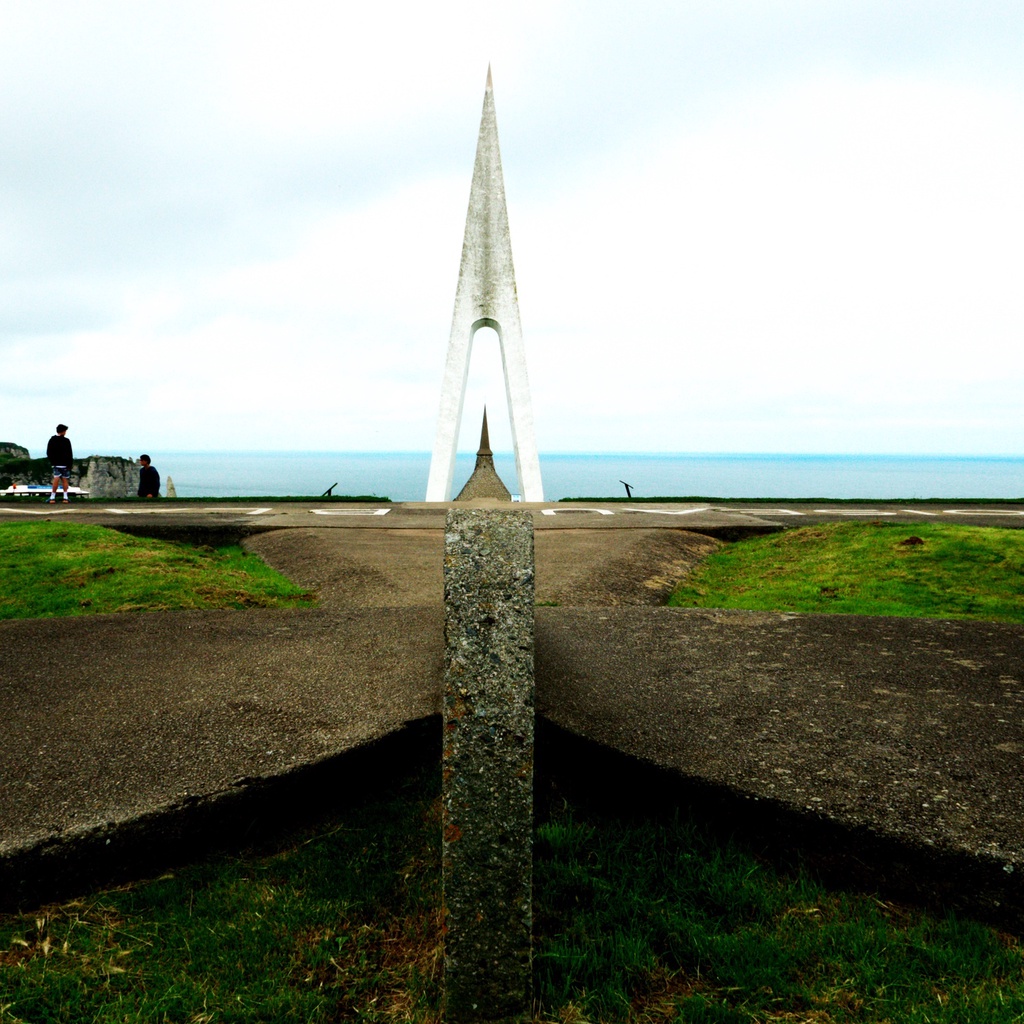
Monument Nungesser et Coli
About Monument Nungesser et Coli
The Monument Nungesser et Coli is a striking 24-meter tall white concrete spire on the Falaise d'Amont cliff, commemorating French aviators Charles Nungesser and François Coli who attempted the first non-stop transatlantic flight from Paris to New York on May 8, 1927. This was the last point in France where their aircraft L'Oiseau Blanc (The White Bird) was seen before disappearing over the Atlantic, just 12 days before Charles Lindbergh completed the crossing in the opposite direction. The original monument from 1927-1928 was destroyed by German forces during World War II, and the current modernist memorial designed by architect Gaston Delaune was erected in 1962-1963. The dramatic inclined spire points skyward at 60 degrees, symbolizing the aircraft's trajectory as it departed France on its fateful journey. Visitors can also see a concrete silhouette of the plane and informational plaques about these pioneering aviators. The site offers breathtaking panoramic views of Étretat's famous white chalk cliffs, the Manneporte arch, and L'Aiguille (the Needle). The monument is freely accessible 24/7 year-round and can be reached by climbing 341 steps from the beach or by car via Avenue Damilaville.
Interesting Facts
Charles Nungesser was known as "The Indestructible Ace" and flew with a terrifying insignia: a skull and crossbones beneath a coffin with candlesticks, painted on a black heart. By the end of World War I, his medical record listed skull fractures, multiple jaw fractures, bullet wounds in his mouth and ear, dislocated knees, wrists, and ankle, and "contusions too numerous to mention" - yet he continued flying and often had to be carried to and from his aircraft.
The mystery of L'Oiseau Blanc remains one of aviation's greatest unsolved cases. Evidence suggests Nungesser and Coli may have actually completed the crossing before crashing near Newfoundland or Maine - which would make them the true first to cross the Atlantic non-stop, 12 days before Lindbergh's famous flight. In 2017, Paris officially updated a street plaque acknowledging they "crossed the Atlantic" rather than merely "attempted" it.
The original 1927-1928 monument was deliberately destroyed by German forces during World War II occupation. The current striking modernist memorial, designed by architect Gaston Delaune, wasn't erected until 1962-1963, featuring a dramatic 24-meter white concrete spire angled at 60 degrees to symbolize the aircraft's departure trajectory toward America.
François Coli, who served as navigator, wore a distinctive eye patch over his right eye which had been injured during World War I. A former ship captain turned aviator, he was a specialist in celestial navigation and had been planning a transatlantic flight since 1923, bringing crucial maritime navigation skills to the aerial crossing attempt.
Planning Your Visit
Opening Hours
Location & Practical Info
Address
9 Avenue Damilaville, 76790 Étretat, France
Day Routes
Explore all day routesThese carefully curated day itineraries include this attraction and show you exactly how to plan your visit, including transport, timing, and what else to see nearby.
Want to visit this attraction? These routes show you how to get here and what to combine it with.
Multi-day Itineraries
View complete itinerariesPlanning a longer trip? These multi-day itineraries incorporate this attraction into complete travel experiences with accommodation, transport, and daily schedules.
This attraction is featured in comprehensive multi-day trips with full logistics included.
Entire Normandy in 12 days
Caen → Bayeux → Granville → ...
Complete Seine-Maritime in 18 days
Dieppe → Le Treport → Rouen → ...
Alabaster Coast in 9 days
Le Havre → Fécamp → Dieppe → ...