Church of Our Lady of Caudebec-en-Caux (Église Notre-Dame de Caudebec-en-Caux)
About Church of Our Lady of Caudebec-en-Caux (Église Notre-Dame de Caudebec-en-Caux)
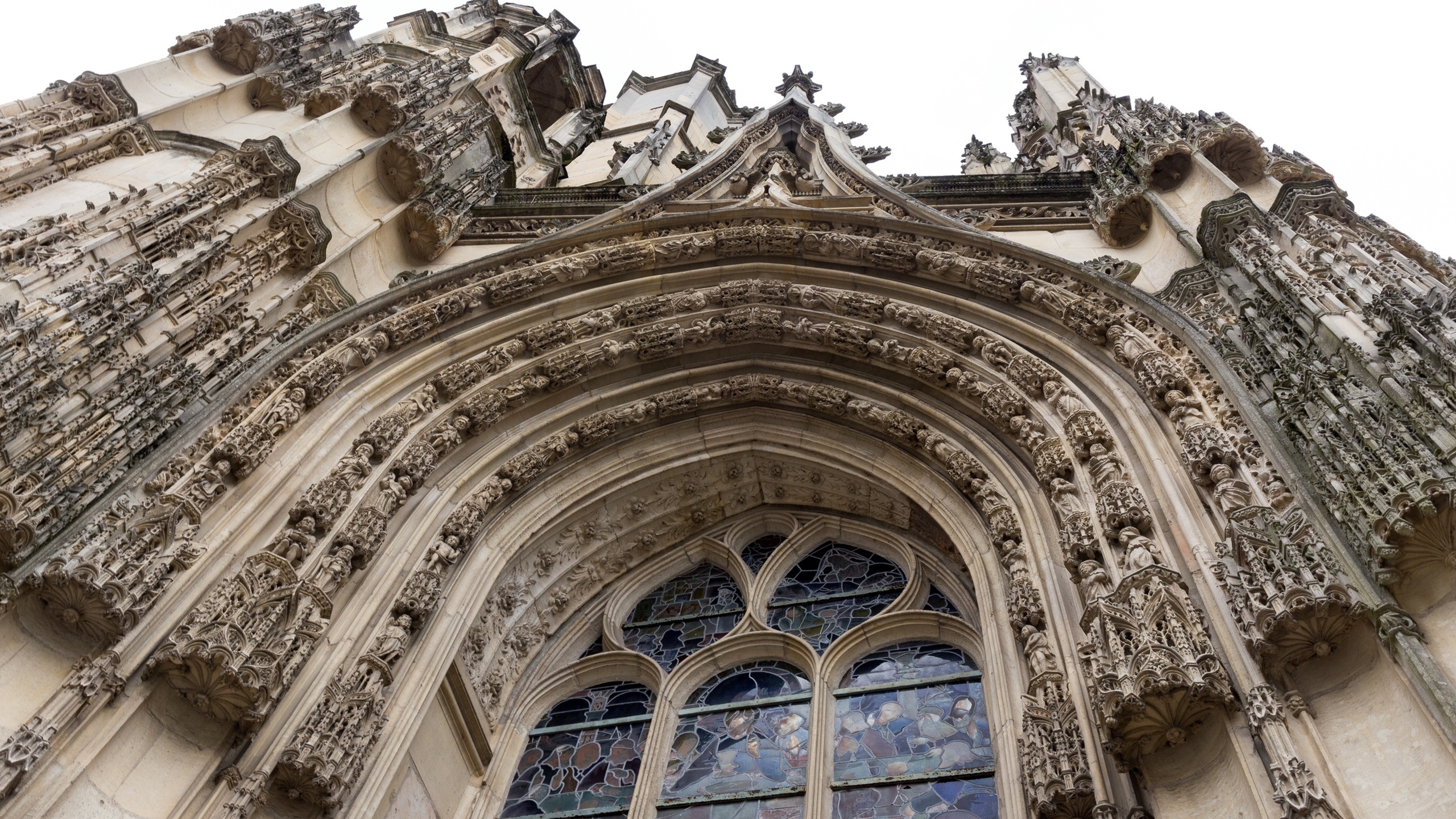
The Church of Our Lady of Caudebec-en-Caux is a masterpiece of Gothic Flamboyant architecture, built between 1426 and 1484 during the English occupation of Normandy. King Henri IV famously called it "the most beautiful chapel in my kingdom," while Victor Hugo described it as "a lace of stone" for its extraordinarily delicate stonework. The church features a spectacular 54-meter openwork spire known as the "Tiara of Caudebec," one of the most elaborate in Europe, with three tiers of fleur-de-lis crowns. Inside, visitors can admire remarkable 15th-16th century stained glass windows, including the rare "English Windows" depicting St. George and St. Michael, and a magnificent Renaissance organ from 1542 with one of France's finest organ cases. The west portal showcases 333 original sculptures depicting saints and medieval daily life scenes. Classified as a Monument Historique in 1840, the church is currently undergoing a 14-year restoration program, but remains fully open for visits and worship. Entry is free, and the church offers a peaceful atmosphere on the banks of the Seine, with ongoing restoration work adding an interesting dimension to the visit.
Interesting Facts
The church was built during the English occupation of Normandy in the Hundred Years' War, and one of its oldest stained glass windows was donated by Foulques Eyton, an English garrison captain. This rare "English Window" depicts St. George slaying the dragon - England's patron saint - alongside St. Michael, Normandy's patron saint, representing an unusual artistic union of the two warring nations.
Among the 333 carved figures on the west portal is a unique depiction of a musician playing the "loure" - an extinct medieval bagpipe-like instrument from Normandy that has completely disappeared from history. This may be one of the only surviving visual records of this lost instrument.
The church's spectacular openwork spire is currently being completely dismantled stone by stone and rebuilt as part of a €3.5 million restoration project. Each original stone is being catalogued, and those too damaged are being replaced with new limestone carved to match the medieval originals - a process that will take over a decade to complete.
Planning Your Visit
Opening Hours
Location & Practical Info
Address
6 Rue de la Planquette, 76490 Rives-en-Seine, France
Day Routes
Explore all day routesThese carefully curated day itineraries include this attraction and show you exactly how to plan your visit, including transport, timing, and what else to see nearby.
Want to visit this attraction? These routes show you how to get here and what to combine it with.
Multi-day Itineraries
View complete itinerariesPlanning a longer trip? These multi-day itineraries incorporate this attraction into complete travel experiences with accommodation, transport, and daily schedules.
This attraction is featured in comprehensive multi-day trips with full logistics included.